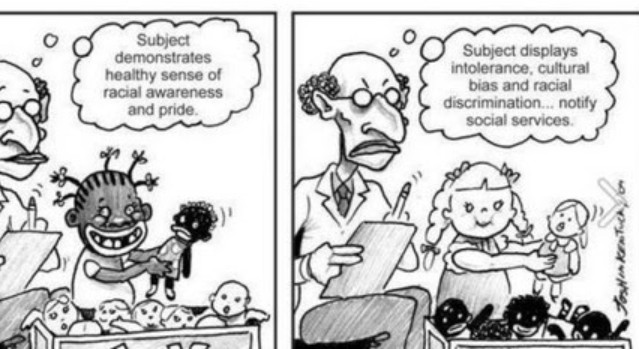
The cartoon caption above is an example of how bias can adversely affect the outcome of research study findings. As individuals we all come with our own internal biases and prejudices. Sometimes these negative perceptions can affect our worldview and the way we interact or see others. In this example a study is being done with 2 little girls, one black and one white both holding dolls of the same race. The black child picks up a black doll from a box of white dolls and is assessed to be functionally normally. The white child picks up a white doll from a box of black dolls and is assessed to be functioning abnormally. On the surface this primarily appears to be the same study which should have found same outcome, yet the assessor makes an irrational, non-scientific outcome interpretation of the available facts. This in turn distorts the final analysis.
The way that I design my research matters, whether it is a qualitative or quantitative approach or a combination of both designs. Research should be geared towards what format would best yield the desired outcome to answer the research question or questions being presented. So, it would be wrong to favor one research strategy over the other. It would be wrong to say, I like this one study better so I will only use this one study.
Data collection is also another important point in the process where my bias can come into play to tilt the outcome, one way or the other. If I pick and choose information in a way that I like or dislike, as opposed to what is scientifically supported, it can lead to skewed results.

When I pull out my data together and analyze the results, I must not let my cultural bias come into play with reporting the research findings. As the cartoon caption above appears to illustrate that some racial bias came into view with the final outcome of the study. In that example, it clearly made the research findings become obsolete or ineffective at the end of the day.
Bias perceptions can not only affect outcome results for an individual and families but can also affect funding to communities in adverse ways. If I for instance only use one racial category of study participants but am trying to apply results to a generalized population, my outcome could be seen as racially biased. Then I would have to re-do the study which could turn out to be a waste of resources, time and money.
I would like to be a credible researcher in social work and therefore will try to check my biases at the front door. At every point in the research process, I have to check and then double check, if my personal biases are interfering with research studies. Therefore, the more I practice this, the more I can have research projects that are reliable and that can be justified and trusted in the social work field. That would be the ultimate way that I can be true to the science and not to my own internal biases.
 Site Title
Leave a comment